I want to create a circuit for a MIDI thru, and I’d like to know if µPisound includes an optocoupler in its MIDI input, in which case I don’t have to add one in my circuit.
Well, the answer is in the docs Detailed Specs - Pisound Micro Documentation
“There’s 2 pins for MIDI output and 2 pins for MIDI input, with MIDI standard compliant opto-isolated circuit behind them.”
See also here for a wiring diagram:
Just to clarify, since there is an optocoupler inside uPisound’s MIDI circuitry, I can just connect two 5-pin DIN connectors in parallel to create a MIDI IN and a MIDI THRU, right?
Take a look at 5 Pin DIN Electrical Specs – MIDI.org - the MIDI IN and MIDI OUT circuits are implemented, but for THRU port, you would need to hook directly to a pin on the other side of the optocoupler which is not exposed in the GPIO headers, additionally, a buffer for the THRU output is also recommended to improve the signal.
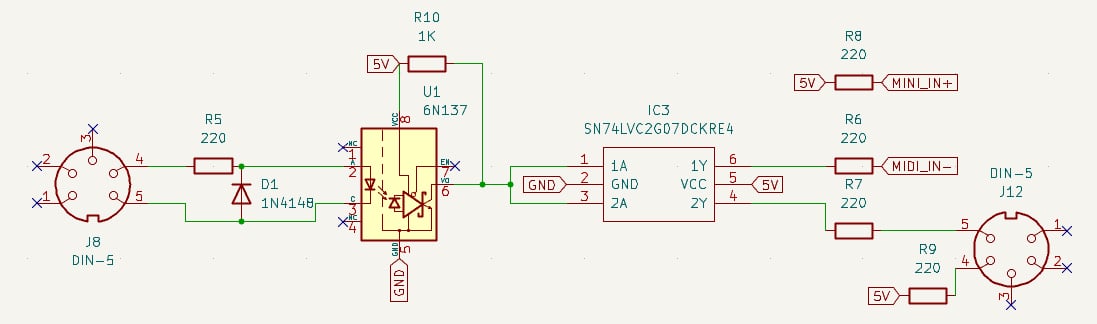
Hey, I think it should work. Two changes - you have MINI_IN+ label instead of MIDI_IN+ and you should connect pin 2 of the THRU connector to GND, pin 2 on the input should remain unconnected. This is necessary for ‘MIDI powered’ devices to work. Generally it can be a good idea to add 100nF ceramic bypass capacitors (one pin connected to VCC, the other to GND) physically close to VCC pins of ICs on the PCB for improved stability & noise performance of the system, in your case, at the U2 and IC3 VCC pins.